
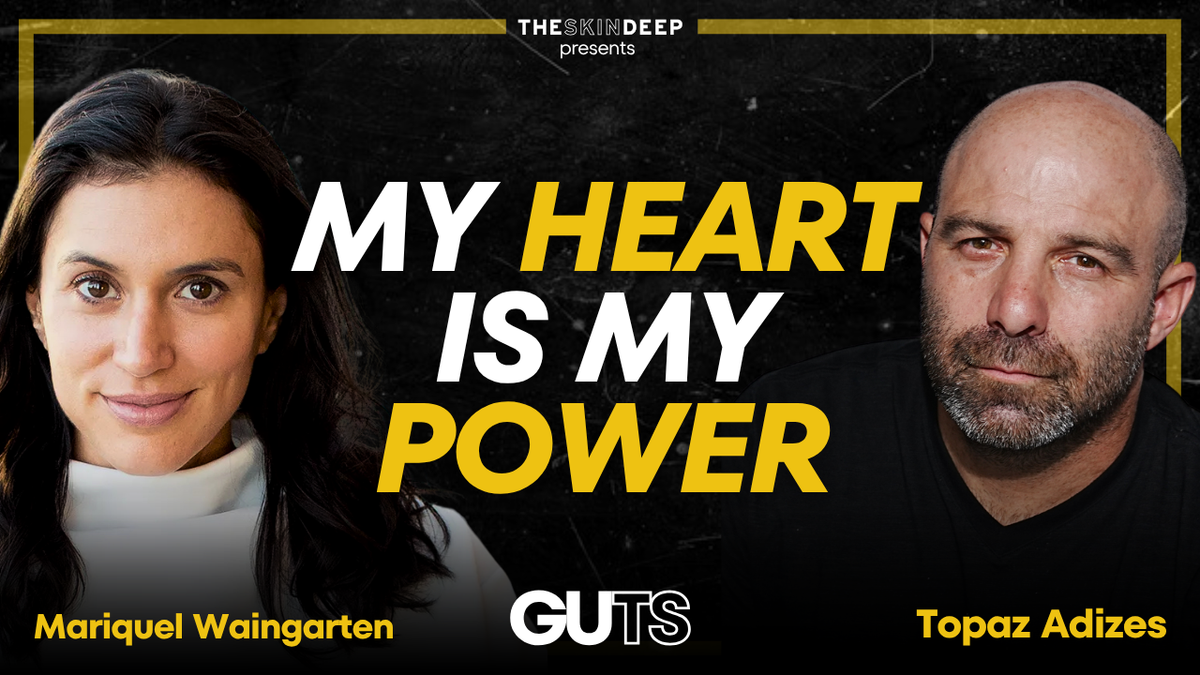
The Katana and the Heart: Mariquel Waingarten on Survival, Love, and Building Spaces Where People Remember Who They Are
Mariquel Waingarten started becoming a samurai at seventeen. That was when her mother passed away. Four years later, her father passed, in their last conversation telling her to leave his problems alone, that everything difficult would die with him, that she was meant for greater things.
Then a family member she trusted offered to check the limits of her land and sold it instead. By the time she was in her mid-twenties, she had learned to read intentions before people revealed them, to cut people off before they could cut her, and to operate in the world with a cold precision she describes as a mask. A personality her ego built to survive.
The mask worked. She built a hotel, then a furniture company, then co-founded Hickies, the shoelace-replacement company that operated in fifty countries. She moved to New York with her husband. She succeeded by every external measure. And she was guided the whole time not by her heart but by the outside stimulus, by the should, by the chase to be chosen and loved and appreciated by a world she had learned not to trust.
Then she had a son. And the mask began to crack.
Drunk With Love
She uses that phrase without irony. When her son was born, she experienced love as a unifying force she had no framework for. Not the love she had performed, not the love she had earned through being useful or indispensable, but something that simply arrived and was bigger than anything she had ever felt before.
And then something quietly revolutionary happened. She realized that the love she felt for him was the same love that had been inside her all along, waiting. That what you can feel for another person is a mirror of what you carry. That the empathy and warmth she had always suppressed in favor of the samurai were not weaknesses to protect. They were the whole point.
The Secret in the Bones
There is a thread in Mariquel's story that runs deeper than the hotel or the shoes or even Portal Bosque. Her parents kept a secret from her about her identity — something about who she was at a fundamental level — and they took it to their graves. She always knew. She had known since childhood, when she would ask and be told no, no, no, until she stopped asking. At almost forty she found out she had been right the whole time.
She describes what it does to a person to know something true about themselves while the world insists otherwise. It makes you physically sick, she says, if you sustain it long enough. And she also connects it to a previous life she accessed in a medicinal ceremony, as a Japanese tribal chief who ignored his own instincts on the eve of a war and watched everyone die. Whether you take that literally or as metaphor, the message is the same: the cost of betraying your own knowing is catastrophic. The samurai was built in part to protect against that betrayal ever happening again. Never let anyone talk you out of what you know.
From Wound to Gift
A mentor told her something that cracked her open: you can build from your wound or from your gift. Both are powerful. Leaders who build from their wound accomplish extraordinary things. But what emerges when you build from your healed self is exponentially larger. The trick is that if you have spent your whole life learning to survive as a samurai, laying down the sword feels like death. You put it in the corner, she says. You don't throw it away. You just stop leading with it.
Portal Bosque is what leading from the gift looks like. A ten-hectare nonprofit in the pine forest outside La Barra, Uruguay, it is simultaneously a cultural center, a learning environment, a community space, a restaurant, and something that cannot be neatly categorized because it was never designed to fit a category. It was designed to be a portal. To transform the people who walk through it from spectators of life into creators of their own. It now serves over 500 member families and runs with 40 staff, 80 instructors, and 20 educational guides. It is the most fully expressed version of everything Mariquel has always been, built not from what she needed to survive but from what she actually loves.
The Father's Last Gift
She goes back often to that final conversation with her father. She was twenty-one, he was drowning in business problems, and she offered to help. He said no. She says at the time she obeyed because she was still programmed to please him above everything. She didn't understand that he was freeing her. Only later did she see it for what it was: the greatest act of love he did before passing. He took his problems with him. He refused to pass the weight. He sent her forward onto a path entirely her own.
His last words to her were: “you are meant for greater things.”
She is still figuring out what those things are. And everything she has built suggests she already knows.
The GUTS Lesson
There is a version of strength that is actually fear in a very good disguise. Mariquel Waingarten spent decades building that version, and she was extraordinary at it. The lesson she carried out of the samurai years into the Portal Bosque years is not that the samurai was wrong. It was necessary. It kept her alive. But you cannot build the life you were actually made for while you are still holding the sword.
The question she would ask you: are you creating from your wound or from your gift? And do you know the difference?
Listen to or watch the full episode on YouTube, Apple Podcasts, or Spotify.
Topaz Adizes
Founder of The Skin Deep & host of GUTS
Comments ()