
Pre and Post: Giselle Moor on Grief on a Schedule, Amor Fati, and the Work of Simply Showing Up
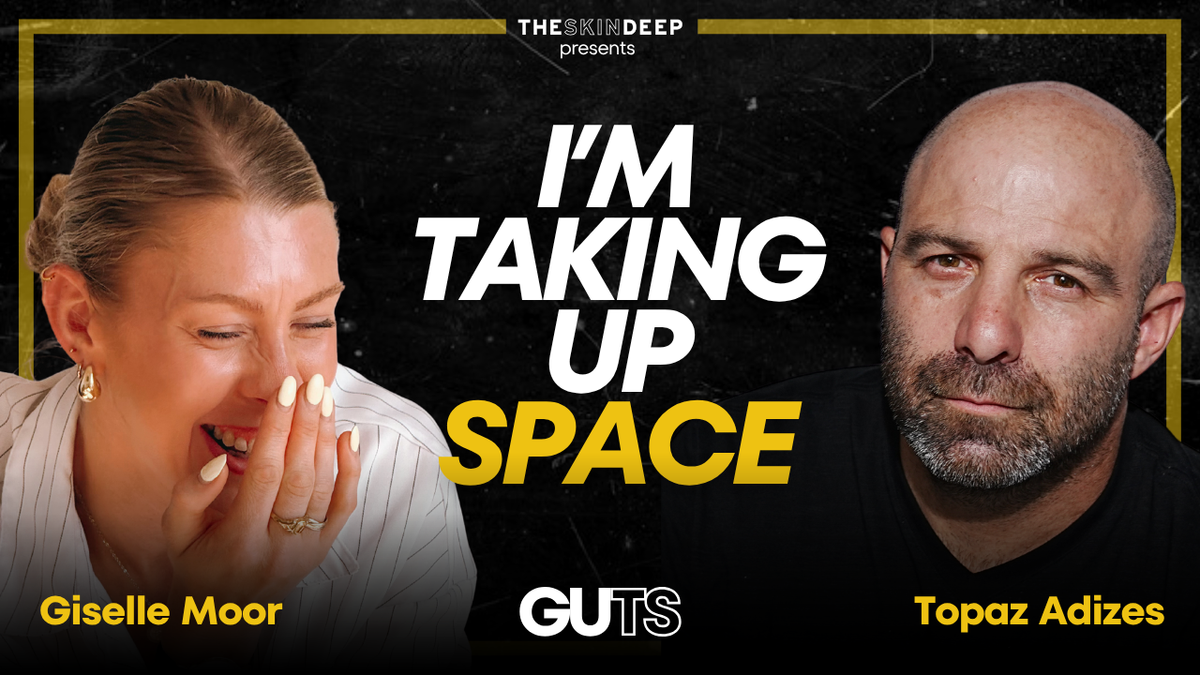
Giselle Moor has a number she returns to without quite meaning to. Six weeks old. That is how young she was the first time her parents brought her to a drag strip, years before she could walk, let alone consent to a life built around speed. By twelve she was racing herself. By twenty four, a wheelie put her in a wheelchair for good. What that number actually says isn’t about racing. It’s that some of the riskiest identities we carry were installed before we ever had a vote in them.
As a wheelchair marathon runner with four marathons finished, a woman who has rebuilt her identity twice, once after a spinal injury and once after moving to a country where nobody knew her name, Giselle has landed on an argument most accessibility advocacy never quite says out loud. The work isn’t the email you write about access. It’s showing up, unmistakably yourself, in the rooms that were never built with a ramp for you.
That argument didn’t arrive as theory either. It arrived at a kitchen table at twelve, in a hospital bed at twenty four, in a rhythm of Monday tears she still keeps, and finally on a cobblestone path at a festival that no one had thought to make accessible. Here is how it stacked.
Born Into the Family Sport
Giselle was six weeks old the first time her parents brought her to a drag strip. Her mother raced, her sister raced, her father worked the crew, and by twelve, her parents sat her down at the kitchen table and asked if she wanted a bike of her own. I remember feeling physically sick, she says. I’ve been talking the talk, like I wanna race. And the moment it’s put in front of me, I was like, ooh, I don’t know if I do wanna do this, but it was fine. She said yes anyway.
The identity she built that day, before she’d really chosen it, would turn out to be the one she’d spend the rest of her life defending, then rebuilding, then redefining entirely.
Pre-Wheelie G, Post-Wheelie G
At twenty four, a wheelie left her with a spinal injury and a wheelchair for life. She has her own name for the split. Pre wheelie G and post wheelie G, she calls it, treating the accident less like one tragedy and more like a sliding doors moment, one life that kept going and one that started over. As a rider who used to hit two hundred and ten kilometers an hour, she had imagined every version of what a crash could cost her. None of those ideas ever included becoming disabled, she says, because my brain just couldn’t comprehend that that would be an outcome.
That gap, between what she feared and what actually happened, became strangely freeing. If the worst thing that happened was something she never could have predicted, there was no longer any use bracing for the wrong disaster.
Shedding the Old Identity
After the accident, Giselle moved to Sydney, where, in her words, no one knows who you are, so you get to show up as whoever you want. She had already spent years as a bouncer at London’s Camden Roundhouse and working in fashion. In Sydney she also gave up alcohol entirely, now past five hundred days sober. My hangovers were catastrophic, she says. I also have so many big goals and a nine to five… the math didn’t math, something had to give.
Reinvention, for her, required both moves at once. Distance from the identity she’d outgrown, and removing the one thing still propping that identity up.
The Monday Devastation
Her positivity, she is careful to say, is not the absence of grief. It runs on a schedule. There is a side, I am very emotional, she says. I think one of the reasons why I was able to have a good Tuesday to Sunday was because my Mondays were like pure devastation. I was crying from the moment I woke up until quarter past five.
The lesson underneath her resilience isn’t that she doesn’t feel the loss. It’s that she has built a disciplined ritual for feeling it fully, on schedule, so it doesn’t leak into the rest of her week.
Finding Amor Fati
Ten years before her own accident, three deaths in a single August, two of them young people, left her with an unnamed feeling that tomorrow isn’t guaranteed. After her accident, she found the words for it in Stoic philosophy: amor fati, memento mori. I found a language for everything that I’d been thinking and feeling and how I operate as a person, she says.
She didn’t just learn to cope with an unpredictable life. She built an entire framework around the idea that nothing has to be labeled good or bad, it simply is, and what you make of it is the only part that was ever yours to choose.
Simply Existing as the Work
At a UK festival, on a cobblestone path her wheelchair couldn’t cross, a friend carried the chair while her partner Jay carried her. The festival’s founder, watching, was visibly mortified that no one had thought to make the path accessible. Giselle realized in that moment that her presence had done something an email never could. Me actually actively going and being an example right in front of them was going to do way more for challenging their ideas than me writing an email about access from the laptop, she says. This is how I’m going to change and challenge is by simply doing, by doing and being there.
This is the actual thesis behind everything else she does, the marathons, the run clubs, the nightclubs until four in the morning. The work was never the advocacy. It was showing up, unmistakably herself, in rooms that were never built with her in mind.
The GUTS Lesson
Giselle Moor’s life reads like an argument for taking up space rather than earning permission to. She learned to want things before she could vet them, at a kitchen table at twelve. She learned that the disaster you actually get is rarely the one you rehearsed. She learned that grief on a schedule is still grief, fully felt, just organized.
What makes her story worth hearing is that she never turned her body into a cause. She turned it into a fact, one she brings, unannounced, into nightclubs and festivals and nine to fives and marathon starting lines, and lets the room do the work of adjusting.
The question Giselle would ask you: what is the room you’ve been staying out of because you weren’t sure you belonged there, and what would happen if you just showed up anyway?
Listen to or watch the full episode on YouTube, Apple Podcasts, or Spotify.
Topaz Adizes is the Founder of The Skin Deep, an experience design studio focused on the transformative power of human connection. He is also the host of the podcast GUTS (Getting Under the Skin) and author of 12 Questions for Love.
Comments ()