
The Dragon Scales We Can't See: Daryn Reicherter on Trauma, Justice, and the Art of Staying Open
In Nietzsche's philosophy, the lion must fight a dragon whose scales are made of the things you believe about yourself that you've never stopped to question. I'm not a horse person. I can't do math. That's too big for me.
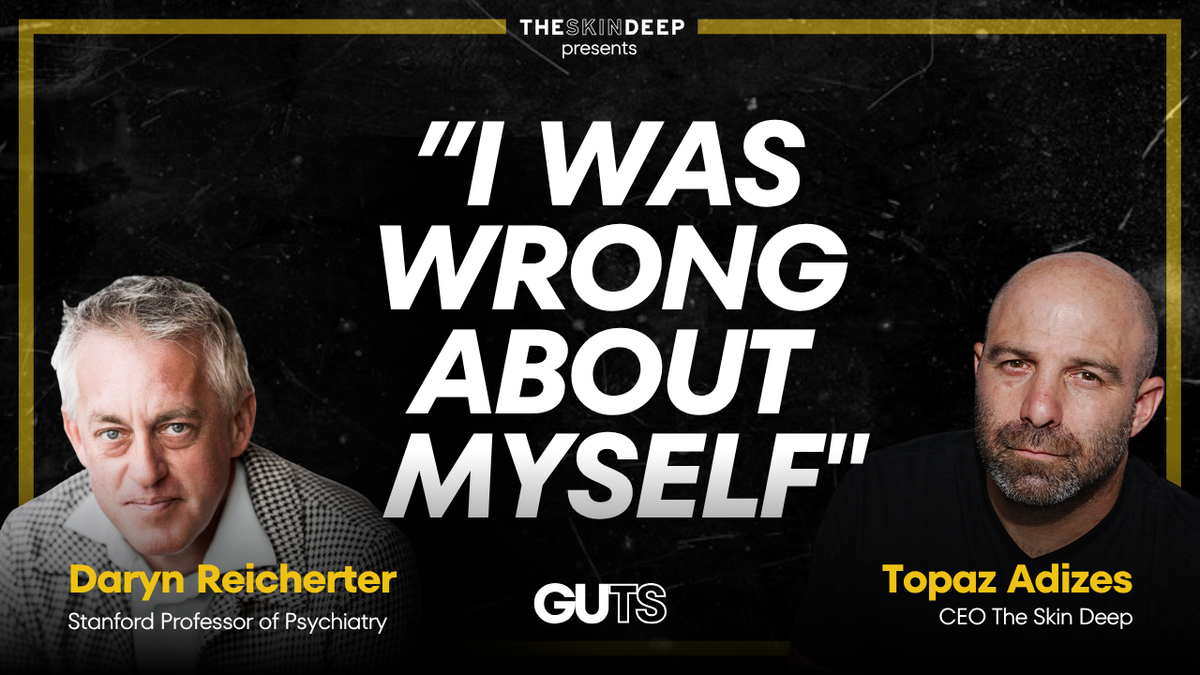
Daryn Reicherter, clinical professor of psychiatry at Stanford and director of the Human Rights in Trauma Mental Health Laboratory, uses that metaphor a lot. He also lives it — which is a different thing entirely.
The Grandfather Who Didn't Speak
Daryn grew up knowing almost nothing about what his grandfather had been through. Born in Holland under Nazi occupation, his grandfather was taken from his farm as a young, able-bodied man and put to work in a labor camp. He endured beatings, starvation, and conditions the family only pieced together from fragments. What they know for certain is that he escaped, driven by the news that his wife was about to give birth, and spent the rest of the war hiding in the northern Dutch countryside, hunted, under threat of execution.
He rarely spoke about it. When he did, he said simply: it was really hard.
Daryn doesn't claim a straight line between his grandfather's silence and his life's work. He resists that kind of tidy narrative. But there's something in the pattern that's hard to dismiss: a man whose most formative story was the one that couldn't be told, who grew up to spend his career giving language to exactly that, the suffering that courts, governments, and history have systematically refused to count.
The Gap Nobody Was Filling
Daryn's great insight wasn't about trauma itself. It was about the space between trauma and power, the gap where human suffering existed but had no formal standing, no legal weight, no dollar value. When the Nuremberg Tribunal prosecuted Nazi crimes, the categories were murder, property damage, territorial violation. Nobody was accounting for the psychological wreckage. Nobody was measuring what it meant to carry PTSD for fifty years, or what happened to the children of genocide survivors, or how an entire culture processed the knowledge that God, in the worldview of a Banda Aceh tsunami survivor, had sent a wave to punish them for their civil war.
Daryn saw that void. And he realized that if you could describe trauma with enough precision, enough scientific rigor, enough cross-cultural nuance, you could take it into a court of law and ask for money. Not as metaphor. Not as testimony. As evidence.
His first expert report, submitted to the Khmer Rouge Tribunal in 2011, was the first time in international legal history that trauma psychology was formally introduced as a basis for reparations. The court ordered funds. Mental health professionals in Cambodia got paid. And millions of people — quietly, systemically, without a headline — got closer to access to care.
The Ladder Between the Field and the Courtroom
What makes Daryn unusual isn't that he understands trauma. It's that he can hold the rawness of it in one hand — the man in Indonesia who believed the tsunami was divine punishment, the Yazidi woman in Kurdistan processing what ISIS took from her, the Cambodian survivor with one photograph from before the genocide — and translate it, without flattening it, into language a judge can act on.
He describes his role as the junction point: not the person who teaches local mental health workers their own business, but the person who can take what they already know and turn it into an argument that unlocks the money, the policy, the systemic change. In Guatemala, where he's currently writing an expert report that could shift millions of people from asylum-based psychiatric care to community-centered services, his job is not to arrive with answers. His job is to synthesize what's already there and present it in a form that makes a court say yes.
That skill, the ability to stand in the gap between human experience and institutional power, is rare. And it was hard-won. It took two decades of field work, a philosophy degree, a neuroscience background, a willingness to go to Indonesia right after the tsunami when he, by his own admission, didn't know anything yet. It took being wrong enough times in enough places to finally know what was the same everywhere and what was irreducibly different.
The Cost of Carrying It
For all of that, Daryn is honest about the weight the work accumulates. Decades of absorbing the worst of what human beings do to one another takes a toll that no amount of professional training fully prepares you for. He speaks openly about a period in his life when the anxiety became clinical, when the coping strategies he taught his own students stopped being enough, and about the hard, necessary work of rebuilding from that, including finding a therapist who finally helped him process what he'd been carrying.
He also built the Stoked Lab at Stanford as a deliberate counterweight, a course in the psychology of happiness, of peak experience, of asking the questions that elite academic culture tends to defer until it's almost too late. The question he puts to his freshmen at the beginning of every semester still moves me. He takes them to Leland Stanford's grave, reads them Nietzsche and Edgar Allan Poe, reminds them that they're born with a terminal illness called life, and asks: what's on your bucket list? The best answer he ever got was from a young woman from Brooklyn. She said she wanted to be the wise old lady all the little kids come to for advice. He called it the best bucket list he'd ever heard.
That's the Stoked Lab in one answer: not achievement, not prestige, not survival — but the kind of life that means something to the people around you.
The GUTS Lesson
The worst that could happen, Daryn said at the end of our conversation, is that he could stop growing. Not death. Not failure. Not the hard seasons that inevitably come. The worst thing is the growth stopping.
What Daryn Reicherter's life asks of us is whether we've ever sat with our own dragon, not the ones other people named for us, but the ones we built ourselves, scale by scale, so quietly we forgot they were there. And whether we have the courage, once we find one, to ask: is that actually true?
Because sometimes the answer is no. And that's where everything begins.
Listen to the full episode on YouTube, Apple Podcasts or Spotify.
Topaz Adizes
Founder of The Skin Deep & host of GUTS
Comments ()