
Resist Much, Obey Little: Joseph Gerstandt on the Fight, the Waters We Swim In, and the Art of Troubling Both
07:14 There is a Walt Whitman line tattooed on Joe Gerstandt's forearm: resist much, obey little. Not as a declaration of rebellion, but as a daily reminder to stay awake and keep asking whether the things we accept as facts about the world were ever actually chosen.
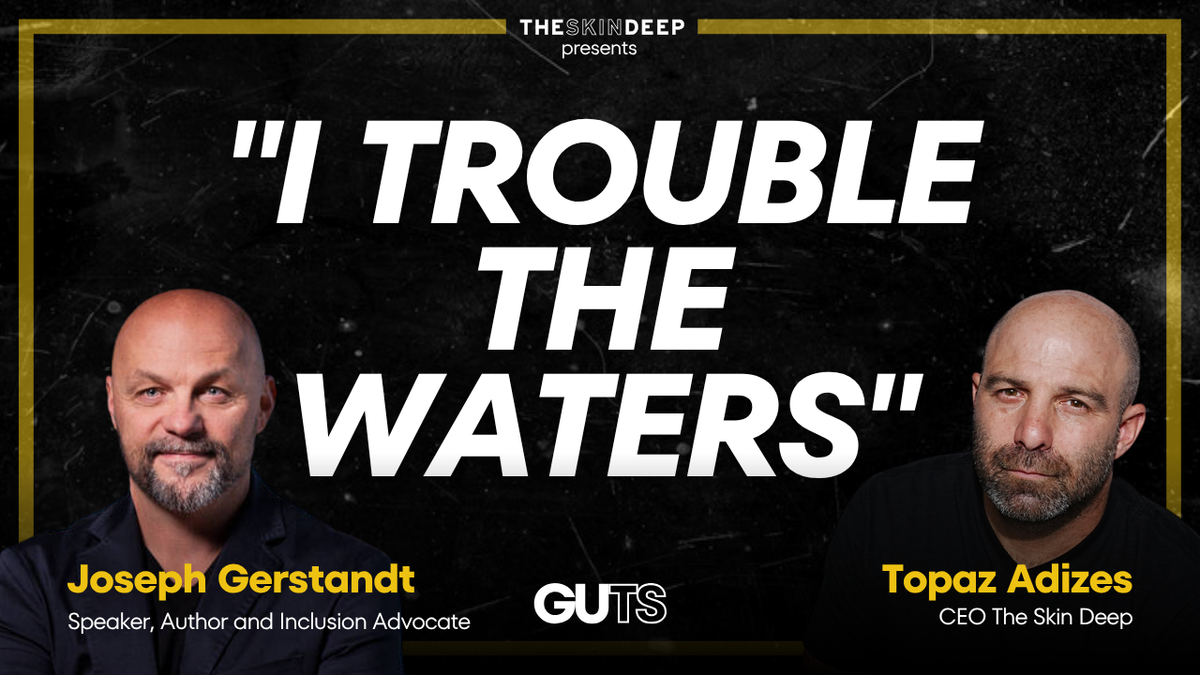
Joseph Gerstandt is a speaker, author, Marine Corps veteran, and one of the most clear-eyed voices working in the fractured space of diversity and inclusion in America today. He's spent nearly two decades advising companies from Boeing to the CIA, co-authoring Social Gravity, and doing the harder, quieter work of helping organizations understand something most of them don't want to hear: their problems are not strategy problems. They are truth-telling problems.
But before any of that, he was a kid on a farm in Iowa who spent the bus ride home wondering whether he was a robot and everyone else was human, or the other way around.
The Boy Who Felt Different
Joseph doesn't describe a dramatic wound so much as a persistent, low-grade bewilderment — a sense, from childhood, that everyone else seemed to know how to do this and he didn't. While his peers in high school had their paths mapped out, Joseph had nothing. No direction, no compass, no clear sense of who he was or what he was for. He joined the Marine Corps partly out of curiosity and partly, he admits, because it was something to do.
What he found there changed him in ways he didn't fully understand until years later. He was pushed beyond what he thought he was capable of. He was exposed, for the first time in his life, to people who didn't look like him or grow up like him. And he bumped — without warning, without malice — into his own bias. He noticed himself making an assumption about a man he was becoming friends with based purely on the color of his skin. It wasn't hatred. It was reflex. And recognizing it as reflex was the beginning of everything.
The Pit in the Stomach
After the Marines and college, Joseph spent six years in corporate sales and sales management. It was, in his words, one of the most miserable stretches of his life. He lay awake at night dreading the next day. He thought the problem was him — that he was too lazy, not smart enough, not built for this. He wasn't. The problem was the fight. The Marine Corps had given him something that corporate America couldn't match: the feeling that what he was doing mattered, that the world was better because he was doing it.
He found his way out not through a plan but through a volunteer role at the Nebraska AIDS Project — and then, in the kind of moment that can only be understood in hindsight, through an email from a woman who was leaving and thought he'd be good in her job. He threw his hat in the ring for a position he was wildly unqualified for. He got it. And something shifted.
As the director of outreach and prevention services for an HIV nonprofit, Joseph was suddenly in the minority — often visibly, almost always culturally. He started seeing things he couldn't unsee: that people who lived in the same city as him were having a profoundly different experience of it, not because of anything they'd done, but because of who they were. He attended a weekend retreat focused on bias and stereotypes and race and gender, and by the end of it, he told the group: I know I can't unsee this stuff. I know this is part of what I'm going to be doing for the rest of my life.
He was right. He was close. And then he got fired — a new baby at home, good health insurance, primary breadwinner — and drove home from that meeting not terrified, but calm. Certain it was time.
The Waters We Swim In
Nearly two decades later, Joseph's work is built on a single, radical-sounding but actually very simple premise: most of us are operating inside stories we didn't write and have never examined. The things we believe about masculinity, about race, about what it means to belong — none of us were at the meeting where those things were decided. We absorbed them. We accepted them as knowledge. And we act from them, often without knowing it.
His particular gift, and it is a gift, is not in delivering answers. He's clear about that. It's in creating the conditions under which people can ask better questions — and feel something while doing it. He brings poetry into boardrooms. He uses the Mother Teresa quote about belonging to each other as a diagnostic tool for organizational health. He believes, with the conviction of someone who has seen it happen, that if you take people who believe they hate each other and put them in a circle with a reasonable amount of safety, flowers will bloom there.
The argument is not soft. It's chemical. He uses the example of carbon, oxygen, and hydrogen atoms: separately, unremarkable. Brought together under the right conditions, they form sugar — and sweetness is a property that exists in none of the individual elements. It only emerges from the relationship. That, Joseph says, is the logic model at the center of the work. Not tolerance. Not coexistence. Genuine emergence through difference.
The Fight and the Work
Joseph is honest that the industry he works in has taken a battering. The politicization of DEI, the budget cuts, the explicit targeting — it has exhausted and bruised the people who do this work from the inside. Joseph watches friends and colleagues who care deeply about humanity spending their days talking to lawyers about what they're allowed to say. It breaks his heart.
But he makes a distinction that I think is worth holding: the work and the fight are not the same thing. Joseph's work may evolve, may shed its current form, may need a new name. The fight — the conviction that human beings telling the truth to each other is the only thing that makes families, organizations, and nations sustainable — that doesn't go away. It can't. It's too close to the bone of what keeps us alive.
He has a Nordic symbol tattooed on his chest, right over his heart: a wayfinder's compass. For a man who has spent his life seeking direction, that placement feels exactly right.
The GUTS Lesson
We spend a lot of time arguing about what the culture has gotten wrong. Joseph Gerstandt's life asks a quieter, harder question: what has the culture gotten into you that you haven't examined yet? What are the waters you're swimming in that you've mistaken for facts?
Resist much, obey little. Not to tear everything down — but to make sure that what you're carrying was worth picking up in the first place.
Listen to or watch the full episode on YouTube, Apple Podcasts, or Spotify.
Topaz Adizes
Founder of The Skin Deep & host of GUTS

Comments ()