
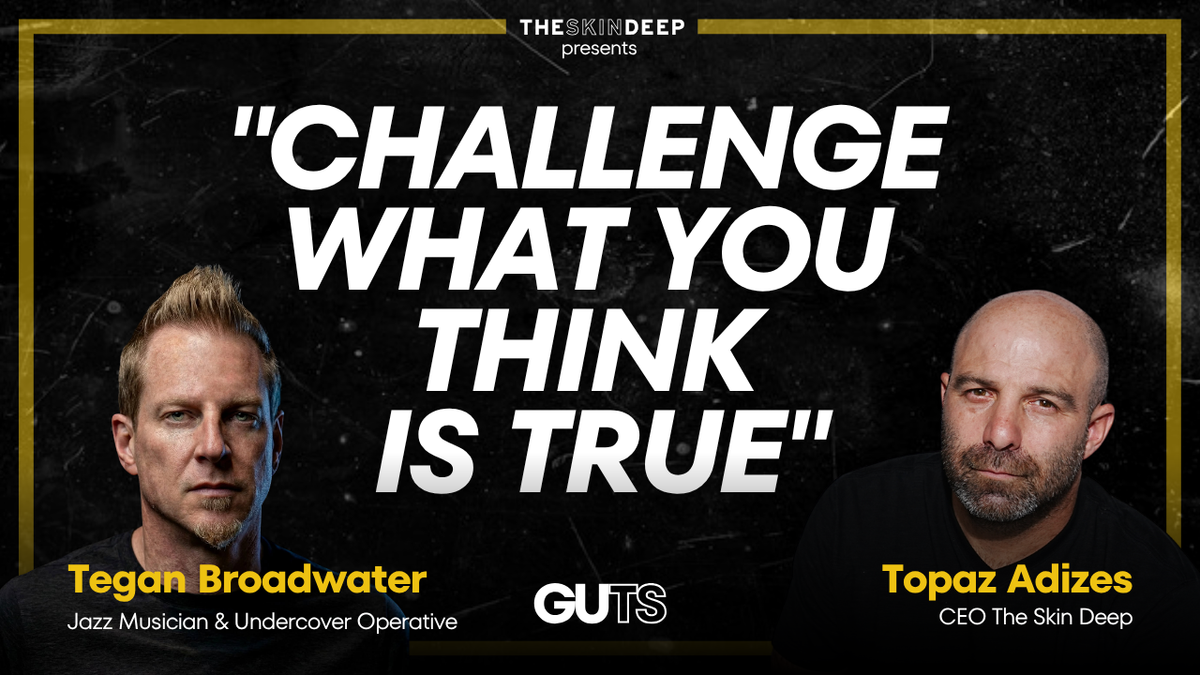
The Compartment and the Compassion: Tegan Broadwater on Code-Switching, Undercover Life, and the 104 Kids He Couldn't Stop Thinking About
Tegan Broadwater moved every two years growing up. His dad was whimsical about jobs. Not military, just restless, and so Tegan became an expert at the skill that would later define his career: arriving somewhere new, shutting up, sitting in the corner, and waiting to see who came over.
In the kind of childhood where you're uprooted every two years, a thousand miles at a time, before the internet, before long-distance calls were cheap, you learn fast that the only thing you control is how quickly you can read a room and make yourself fit into it.
He calls it code switching. It took him from Houston jazz clubs at fourteen to the University of North Texas music program to a touring band burning out in a 1987 Chevy Suburban. Then in one of the more improbable career pivots in American law enforcement history, it took him into the Fishbowl.
The Turn
The turning point from musician to cop is, on the surface, absurd. Some off-duty officers who were fans of his band started hanging around. He was already thinking about leaving music, his son had just been born, the road wasn't working, the dream was fraying. He uttered the words out loud for the first time: I think I'm leaving. They said, you should become a cop. He was a skinny, long-haired kid who'd spent most of his adult life getting harassed by police. He thought about it anyway, and realized what he was actually chasing wasn't the badge, it was the mission. Something that mattered. The music had given him everything except that.
He joined the Fort Worth Police Department, moved through narcotics, gang, homicide, and eventually the FBI's Violent Crimes Task Force. And then, at thirty-five, he pitched his sergeant on something nobody had asked him to do: go deep cover, alone, into a six-block Crip-controlled neighborhood in southeast Fort Worth called the Fishbowl — one way in, one way out — and dismantle it from the inside.
Tee Cadell
He created a character that was essentially himself with one thing surgically inserted: sociopathy. Not a new backstory, not a fake accent, just Tegan, minus the capacity to feel what was coming. He was a high-end cocaine dealer from South Texas whose source had just been busted by the feds. He presented himself as an opportunity, not a threat. He played Madden. He talked about girls and cars and the Cowboys. He beat guys at video games when he had no cash to spend. He got street cred the honest way.
For eighteen months he lived in both worlds simultaneously, his family's world, where his wife kept him in his lane when he started talking weird or getting emotionally distant, and the Fishbowl's world, where the grandmother raising four grandkids on a block she couldn't leave deserved someone to go in and make it safer. Both felt real. That was the point.
The Thing That Came Rushing Forward
The moment the US Attorney's office said they were wrapping up, meaning 51 targets were about to be taken down, something happened that the compartmentalization couldn't hold. The sociopathic insert was contrived. Once the operation ended, it was just him again. And he was looking at people he knew.
He testified on behalf of four of them. Wrote character statements. Said to the court: this person has social redeeming value. I believe they could make it if given the chance. He had 51 people going to prison, some of them with an average of twenty years apiece. He was wishing the best for some of them and had no more control over what happened next. That's what terrible felt like.
The operation left 104 children without a parent. He donates all book profits to organizations that mentor those kids. The number didn't come from a charity brochure, it came from knowing exactly who each of those kids was because he'd met their fathers.
The Marriage Line
When asked to list what he's proudest of in his life, Tegan leads not with the FBI commendation or the Officer of the Year award or the 80-person security firm he built with no business training. He leads with: creating a near-perfect marriage from a disadvantageous beginning. That phrase, “disadvantageous beginning,” is the most revealing thing he says. It points to a version of himself before marriage, a version shaped by always moving, always performing, always code-switching into whatever the situation needed. The work of becoming someone a marriage could be built on is, for him, the real operation.
The Fourth Chapter
He's now in what he calls his fourth chapter. Music at the beginning. Police work. The security business. And now, the creative phase, where all of it feeds into writing, podcasting, recording music that carries actual messages, building something that outlasts any single operation. He describes it as the first time in his life he could pursue passions at the risk of losing money. He had to build financial stability first, through the business, before he could afford to do the work he really cares about.
That's not a compromise. That's the camel's burden becoming the lion's freedom.
The GUTS Lesson
Tegan Broadwater's life is a study in what happens when you are very good at moving between worlds and what it costs, and what it teaches, when the compartmentalization finally opens and you have to look at what was inside it the whole time.
The mortalities pressing on him now, people around him dying young, are clarifying something. Not urgency exactly, but accountability. The question his life keeps asking is the one he'd probably ask you: what are you compartmentalizing that you haven't looked at yet? And what's it going to take for you to look?
Listen to or watch the full episode on YouTube, Apple Podcasts, or Spotify.
Topaz Adizes
Founder of The Skin Deep & host of GUTS
Comments ()