
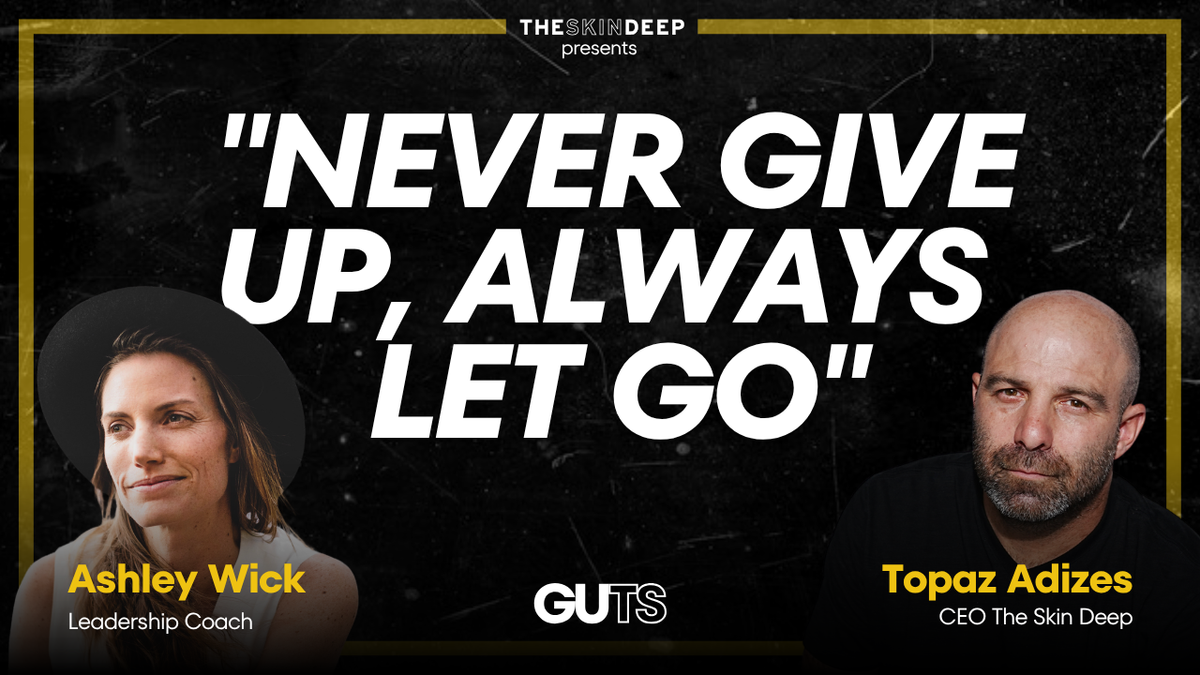
The Jar Can't Read Its Own Label: Ashley Wick on Belonging, Breakdown, and the Art of Listening to Your Life
There is a principle Ashley Wick returns to often in her work: you cannot read the label from inside the jar.
No matter how self-aware you are, no matter how many frameworks you've studied or retreats you've attended, there are things about yourself that can only be seen from the outside, through the friction of other people, the mirror of a conversation, the unexpected arrival of a life event you didn't ask for. Ashley Wick has built her entire practice around that gap between who we think we are and what we actually carry. But the more interesting story is how she got there.
The Floater
Ashley grew up the middle child in a family where everyone's gifts seemed obvious. Her sister was a photographer. Her older brother was an artist and interior designer. Her father was a merchant banker. The gifts had visible shapes. Hers didn't. She was athletic, multi-passionate, interested in everything (what the Enneagram would eventually tell her is a classic Seven profile) and that very openness made belonging slippery. She had athletic friends and academic friends and social friends. She never quite belonged to any one group. She was a floater.
The memory that surfaces in her regressions is small and specific: a field trip to the Exploratorium in San Francisco, a bully in her friend group, a moment when she was told, without those exact words, to move away cause she didn’t belong. She didn't stand her ground. She felt displaced. And that hollow feeling in her chest, she says, has shown up in every major chapter of her life since. It's the root thread.
The Chameleon
She moved to New York and built a successful career in publicity and PR finding and amplifying the essence of other people's work. The irony only became clear later. The skill set she'd developed to survive not belonging, of reading rooms, adapting, becoming what each environment needed, turned out to be exactly what the PR industry rewards. She was good at it. But she was also slowly diluting herself inside it.
When the 2008 financial crisis contracted the industry and gave her an unexpected pause, she stumbled into a coaching course. What happened in that classroom was immediate and physical. This, she thought. This is the deep contact I've been wanting. Not with clients or brands but rather with herself and other people. The digging she'd been doing for others could finally turn inward.
The Call at 10pm
The real rupture came in her early thirties, in the middle of a Landmark Forum advanced course. A woman stood up in front of two hundred people and shared, in raw detail, a story of childhood abuse. Ashley sat there not just witnessing courage but she recognized something. She had her own unconfronted wound.
That night, at ten o'clock, she snuck into a restaurant near midtown Manhattan and called the person who had abused her in childhood. The conversation came as a blur. What surprised her most was what she felt: not rage, not vindication, but compassion. The woundedness of the person on the other end was so visible. Hurt people hurt people. She felt it, not as a concept, but as a physical truth. That phone call, she says, was when her sense of self began to flesh out in a new way.
Never Give Up, Always Let Go
A few years later, Ashley and her husband Oliver moved from New York to Boulder, Colorado, explicitly to slow down, to live closer to their values, to be more present. On a morning hike, they acknowledged the uncomfortable truth that their results were showing them something: they had moved their bodies to Boulder but hadn't moved their lives. That afternoon, they went in for a twenty-week ultrasound and learned their daughter Lucinda had a heart condition.
What followed was six months of not-knowing, questions about the heart, the kidneys, possible neurological conditions, and then, three days after Lucinda was born, open-heart surgery. Ashley describes handing her newborn to a nurse and walking away as the closest she has ever come to pure surrender. And what she found in that space, stripped of any ability to perform or achieve her way through it, was the thing she'd been looking for her whole life: presence. Life delivered it the only way it could.
A yoga teacher had given her a paradox she keeps returning to: never give up, always let go. She was never going to give up on Lucinda. She also had to let go. Both were true at once.
The Possibilist
Ashley is now living for a year abroad in Uruguay, running Fertile Ground remotely, speaking less and listening more. She's learning Spanish slowly, which means she sits at dinner tables unable to contribute and has to simply be present in the discomfort of not understanding. She describes it as the medicine her overachiever brain needed and is still learning to take.
When asked what life has designed her for, she uses a word she may have invented: possibilist. Someone who sees the possibility in people and in things and helps them see it in themselves. It's not an accident that the woman who spent decades learning to see the label from outside the jar now makes her living helping others do the same.
The GUTS Lesson
The shape-shifting, the pleasing, the performing to belong, Ashley Wick's story suggests none of it was wasted. All of it became material. But so did the phone call at ten o'clock, the newborn handed to a surgeon, the morning on the trail when she asked for presence and didn't realize what answering that request would cost.
The breakdown became the breakthrough. And the breakthrough became, eventually, the work.
The question she'd ask us: what are you not saying, not yet, and why are you still hesitant to?
Listen to or watch the full episode on YouTube, Apple Podcasts, or Spotify.
Topaz Adizes
Founder of The Skin Deep & host of GUTS

Comments ()