
The Cockroach and the Sacred Stage: Santiago Cumplido on Magic, Shadow, and the Art of Small Ripples
Santiago Cumplido wanted to be a magician. Not metaphorically — literally. When adults asked the small boy from Guadalajara what he wanted to be when he grew up, he said mago. They gave him trick kits and prop sets.
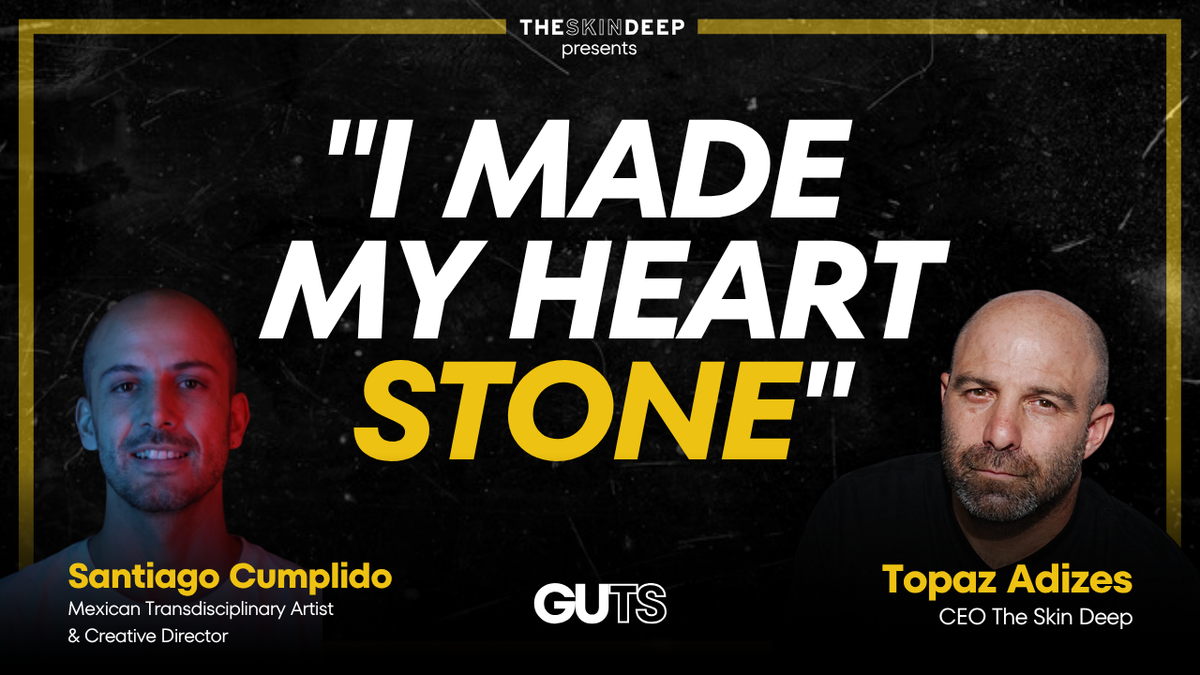
And then he discovered the tricks were just tricks, that there was no real magic in them, and he shifted his answer: musician. He didn't know then that he'd spend the rest of his life looking for the same thing — a force strong enough to take you completely, to overflow you, to make you cry in the living room alone at five years old listening to Pink Floyd without knowing why.
He's still looking. And what he's found along the way is the subject of one of the most surprising conversations I've had on this show.
The Stone Heart
At sixteen, Santiago left for a music conservatory in Morelia with two things happening at once: his first love had just tried to take her own life — he'd last seen her in a psychiatric ward with bandages on both wrists — and he had nearly deafened himself in an explosion a few days before leaving. He arrived in a strange city, hearing only a constant ringing, cycling through depression and medication, studying music he could barely hear.
He recovered his hearing over several months, thanks to a doctor who gave him medicine and refused payment. But the emotional wound from that first love stayed longer. He cried every day for a period — deeply, privately — and then one day made a decision so clear he still remembers its weight: I'm going to make my heart stone. He went to sleep one person and woke up another. He stopped crying. He couldn't cry again for years.
He says this matter-of-factly, without drama. But it's the hinge on which his whole story turns.
The Yes Man and the Good Star
What followed was two decades of being invited into extraordinary situations and saying yes to all of them. A conservatory in London, funded by fundraising concerts for wealthy families in Mexico. A full scholarship handed to him at a royal gathering in England by a dean who couldn't understand why a student from his own school was in the room. An ambassadress of Spain who sent him to Barcelona, paid for his studies, and later arranged for him to study at the best baroque music school in the world in The Hague — with a BMW and chauffeur waiting at Miami airport when he needed healing work in Florida.
His sister Paloma, an astrologer, says he has Jupiter in his chart. Good luck. He doesn't entirely disagree, but he adds something else: a genuinely clean heart. He can sit with your happiness, your success, your fullness, and feel glad for it without the undertow of envy. That quality, he thinks, is why strangers keep giving him things.
But the luck has always had a shadow. Every era of his life also produced an antagonist — someone who locked him in a hotel room for no reason as a child, a sub-director who turned his scholarship to smoke and sent him home without a degree, an alpha male in a healing school who invaded his most vulnerable moment. He spent years washing each of them off and moving on, until two years ago when he finally sued someone for the first time — for taking his art without permission — and felt something shift. A belated boundary. A new kind of respect for his own work and the weight of what he creates.
The Basement and the Breakthrough
The real pivot came in his late twenties, when a woman he loved handed him a book and an ultimatum: go to therapy or leave. He picked up Hands of Light by Barbara Brennan and couldn't put it down. He went to his first therapy session with a PathWork practitioner who told him, with zero ceremony: you can meditate your face off until the end of time. Until you deal with the bullshit you're doing, nothing will happen.
He was hooked. Not because he wanted discomfort, but because he recognized it. He had always been someone who, when healthy discomfort arrived, heard it as a signal — what is this showing me about myself? That curiosity over defensiveness became the central upgrade of his life. He spent years in healing training, first in Miami, then in Guadalajara, learning to go into the basement instead of sealing it.
What he found there surprised him. Once he stopped protecting his wounds — from obvious things like argument and stubbornness, to subtler ones like performing coolness or beauty he didn't feel — he could sit with other people's pain and feel something clean for them. Compassion arrived. Love arrived. Not the kind that's traded for safety, but the kind that simply shows up when you're no longer spending all your energy on the lock.
The Sacred Third Call
All of that feeds into how Santiago makes work now. He is, in the most precise sense, a total artist — composing, directing, designing lights, writing scripts, casting performers, conceiving the stage architecture — all for shows that begin, for him, in music. Before a single note is written, he hears the structure in rhythmic and tonal terms. Eight dancers need these drums. This passage requires brass. A white laser follows that sound. The music doesn't describe what happens on stage — it predicts it.
His most recent work, EGREGOR, is perhaps his most unguarded: an immersive sensory ritual about artificial intelligence and the collective unconscious, composed partly in deliberately broken reggaeton — time signatures warped into 5/8 and 11/8 so the familiar rhythm stumbles and collapses — staged at Mexico City's Instituto Cultural Helénico with butoh dancer Vangeline. It's about what happens when humans project their inner world onto machines and mistake the reflection for intelligence. It is, underneath all the spectacle, a meditation on what we're running from.
But when asked what his work is really for, he answers with something quietly devastating: small ripples. Not stadiums. Not legacies. Not the Picasso cover. Every show he has ever sung in, composed for, or directed has touched at least one person deeply. One old woman dying of sadness who found something in a production that shifted something inside her. That, he says, is probably what he was designed for. Not the masterpiece. The moment inside the masterpiece that no one in the press noticed but that one person carried home.
The GUTS Lesson
Santiago Cumplido sat in a living room at four years old, crying at music he had no words for, and knew that whatever that force was, it was real and worth chasing for the rest of his life. He turned his heart to stone at sixteen because life was too much. He spent the next two decades slowly, accidentally, letting it melt back open.
The lesson he carries now is one of the most honest I've heard: looking at your ugly side — your wounds, your shadow, your imperfections — is not the price of growth. It's the gift. When you lose the fear of your own darkness, you stop spending your energy on the lock. And in that freedom, you can finally hear other people. You can finally make something that means something. You can finally be magic, not just perform it.
Listen to or watch the full episode on YouTube, Apple Podcasts, or Spotify.
Topaz Adizes
Founder of The Skin Deep & host of GUTS

Comments ()