
Feeding the Jaguar: Gabe Orta on Inherited Patterns, Presence, and the Work of Finally Seeing What You Carry
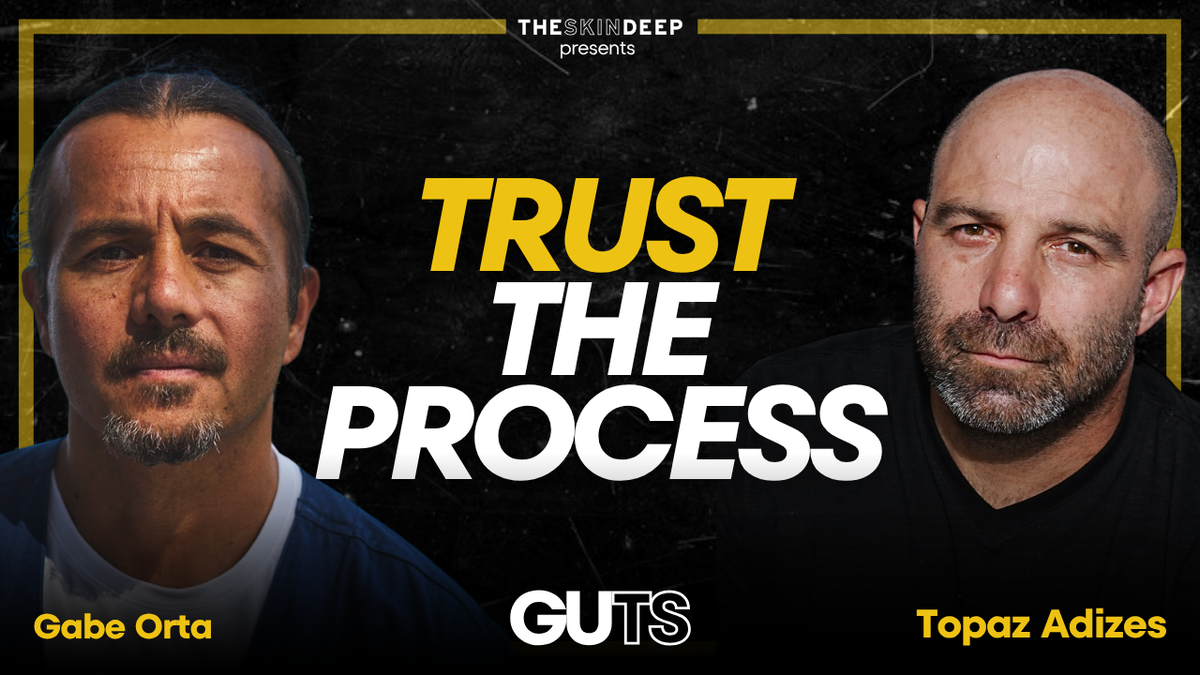
Gabe Orta was ten years old when his family disappeared in two weeks. His grandmother, the matriarch who had built the family’s wealth trading electronics out of Medellín, was killed. So were his father and his uncles. The farms went, the properties went, and the family moved into hiding inside the only house the narcos had not taken. At the wake, standing in front of his father’s coffin, a voice came to Gabe that he still cannot place, repeating one line in Spanish: everything is going to be okay, you have to trust this process. He did not know what to do with a voice like that. He just let it hold him. What he did not know yet is that whatever gets buried that early does not disappear. It goes underground and starts running the show from there.
As the co-founder of Bar Lab Hospitality, the team behind the award winning Broken Shaker, and the creative force behind some of the most celebrated restaurants and hotels in the country, Gabe has spent three decades building rooms designed to make strangers feel something. But the argument he actually wants to make, the one he keeps returning to in his own language, is not about hospitality. It is about what he calls the program: an inherited pattern of fear or grief that runs in a family’s subconscious like software, showing up not just in how you feel but in the food you cook, the business you build, and the people standing closest to you, whether you ever agreed to carry it or not.
He did not arrive at that idea from a book. He arrived at it by catching himself, at fifty, still running the same loop he learned to run at ten. Here is what it taught him.
The Program, Named
Gabe found the language for this years into building his businesses, through developmental biologist Bruce Lipton and the idea of epigenetics. Not that trauma runs in a family the way a disease does, but that behavior does, loaded into the subconscious the way software gets loaded into a machine. The moment you see the program, he says, you cannot unsee it. He started noticing it in himself first, catching the exact moment a business would start doing well and he would start dissociating, avoiding his own bills, running from a stack of paper the same way he realized that a ten year old once ran from a house that was no longer safe.
The pattern was not a memory. It was live software, still executing decades later, and it did not care that Gabe was now the one signing the checks.
What the Food Was Carrying
The harder realization was that the program did not stop with him. It doesn’t just keep running, he says. It keeps programming our kids, our employees. The food that I’m cooking is programmed with those programs. He describes catching himself tense up walking out of Whole Foods with three bags of groceries, three hundred dollars spent on food, feeling a flash of guilt he could not explain, some old belief insisting he did not deserve to spend that money on himself. Multiply that by a payroll of seven hundred and fifty people and a menu served to thousands of strangers a night, and the scale of what one unexamined pattern can actually transmit stops being abstract.
Left Behind at Seventeen
Some of the program’s oldest material came from Miami. At seventeen, Gabe’s mother and younger sister were deported, and he was given a choice: leave with them, or stay in the country illegally. He stayed, sleeping on couches, looking for a woman to marry just to get papers. I wish I would have been a better son, he says. I wish I would have been a better brother. He describes the day they left as the same abandonment he had felt the day his father died, except this time he was old enough to believe he could have prevented it, which is exactly how a program gets its grip. Not through the loss itself, but through the story that you were somehow responsible for it.
What Grief Waits For
Years later, running his first real success, a pop up bar called Broken Shaker, Gabe watched Mary, the woman who handled the business side he never had a head for, die in his arms after an ATV accident in Costa Rica. I didn’t have time to grieve, he says.. The business kept accelerating and he kept moving with it. The grief did not go away. It waited years, resurfacing only after he met his wife, who had heard the story of Mary before she ever met him. Postponing a feeling does not cancel it. It just adds the interest of however many years you manage to outrun it.
Feeding the Jaguar
Gabe describes an image from his own teachers: a jaguar that lives in the darkness of the jungle within all of us, moving slowly, seeing what we cannot yet see ourselves. If you don’t feed the jaguar, he says, it’s gonna come after you. Feeding it means doing the unglamorous maintenance, the breathwork, the meditation, whatever keeps you looking at what is actually running underneath. He connects it to Chiron, the point in an astrological chart that takes fifty years to complete its orbit and return, carrying back whatever wound got buried in childhood so it can finally be integrated. At forty nine, about to turn fifty, Gabe is raising his eight year old daughter to sit with her feelings instead of push through them, which is another way of saying he is trying, deliberately, to stop the program before it reaches her.
It Needs to Be Fun
After decades of reading philosophy and ancient teachings looking for the answer, what Gabe keeps landing on is almost embarrassingly simple. Kids do not hold grudges. They live entirely in the present, and a day after you yell at them they cannot remember why you were upset. It needs to be fun, he says. No feeling is final. The reprogramming he describes is not grim self improvement. It is closer to remembering something a child already knows, that very little of what feels urgent actually is.
The GUTS Lesson
Gabe Orta’s life reads like a catalog of things no ten year old should survive: a family wiped out in two weeks, a mother and sister deported while he stayed behind alone, a woman who loved him dying in his own arms. None of it broke him, and none of it left him either. It just went underground and kept running, the way a program runs, quietly shaping the food he cooked and the way he flinched at his own grocery bill, until he finally slowed down enough to look at it.
What makes his story worth sharing here is not the hotels nor the restaurants. It is the specific discovery that you cannot out earn or out build a pattern you refuse to see, and that the people closest to you, your employees, your customers, your kids, are the ones quietly inheriting whatever you decline to look at.
What program are you running right now that was never actually yours, and who is standing close enough to catch it next?
Listen to or watch the full episode on YouTube, Apple Podcasts, or Spotify.
Topaz Adizes is the Founder of The Skin Deep, an experience design studio focused on the transformative power of human connection. He is also the host of the podcast GUTS (Getting Under the Skin) and author of 12 Questions for Love.
Comments ()