
The Story You're Telling About Them: Lue Kraltchev on Narrative, Belonging, and the Architecture of Connection
We think of stories as things we tell. What Lue Kraltchev has spent her career uncovering is that stories are also things we live inside of, often without knowing it.
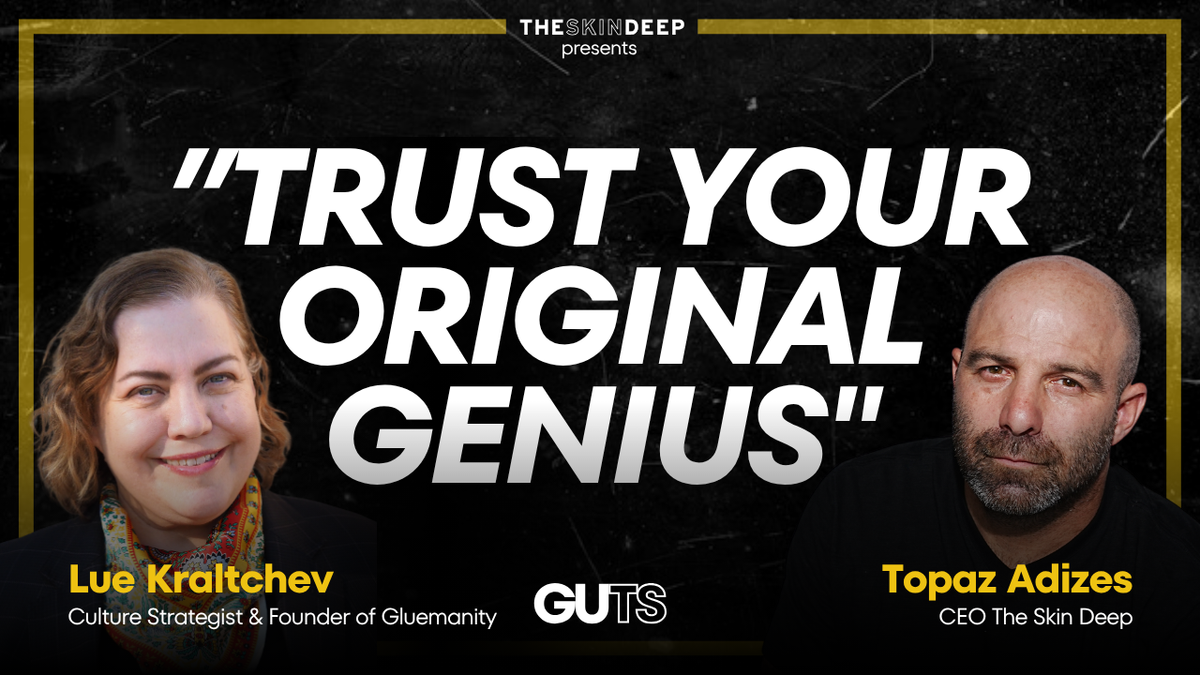
As a culture strategist, polyglot, and doctoral researcher, Lue Kraltchev has spent thirty years in the hospitality industry and is now finishing a dissertation on one of the most overlooked dynamics in organizational life: the narratives that leaders carry about the people who follow them. In my recent GUTS conversation with her, that research became a lens for something much wider, the way all of us move through the world trapped in plots we didn't consciously write.
The Lavender Epiphany
In March 2020, as the world went quiet, Lue walked onto her front porch in Texas and smelled Spanish lavender blooming early. The scent pulled her back instantly — to Nice, France, digging around Bronze Age ruins, studying five languages and living in full color. She heard herself ask: when did you walk away from that girl?
That moment of involuntary memory became an act of reclamation. After eleven years of telling herself the timing was wrong, she enrolled in her master's program. Her husband's first reaction was panic. His second, once he saw her come alive, was: go. What that story illustrates isn't just personal reinvention, it's Lue's central argument: our lives turn on the stories we decide to believe about who we still can be.
The Ladder of Inference
One of the most practically useful ideas in our conversation came near the end. Lue described something her teachers call the "ladder of inference", a model for how stories land, or fail to. At the bottom of the ladder: visceral, sensory language. The dew drops jumping from the grass onto your ankle. At the top: big ideas. Humanity, creativity, belonging. Great storytelling, she argues, vacillates between these two poles. It takes you from the felt to the vast and back again.
The danger zone is the middle, competent, well-structured, utterly forgettable. And that, Lue points out with a kind of delighted precision, is exactly where AI lives. It assembles impressive language that hits neither the body nor the soul. It doesn't tag you to anything. Which is why you can read a beautiful ChatGPT paragraph and remember none of it an hour later. Real stories leave a mark because they move you along the full length of the ladder.
Hospitality as a Human Science
Lue spent three decades in the hospitality industry, not, she insists, as a service professional, but as a student of human arrival. She watched what happened when strangers crossed thresholds: disorientation becoming orientation, guarded becoming open, alone becoming together. She noticed that people digest food differently when they eat in company versus alone, that there is a literal biology to belonging.
What she drew from all of it is something she calls architectural connection: the understanding that warmth isn't something you perform, it's something you design. The shape of a table. Whether food is passed family-style or plated individually. The ritual of pouring tea. These aren't decorative details. They are the mechanisms by which humans decide whether it's safe to put down what they're carrying.
The Narrative Beneath the Conflict
Her doctoral research asks a question that sounds academic but lands like a gut punch: what stories do leaders tell themselves about the people who work beneath them? Not what they say about them, what they believe, often below the level of conscious thought. Because those stories, Lue argues, create divides that no amount of management training can bridge. You can retrain behavior. You cannot retrain a narrative someone doesn't know they're running.
She spent thirty years watching organizations solve the same problems on repeat, and she kept circling back to the same root: somewhere upstream, someone wrote a story about someone else, and then acted as if it were fact.
Going Back to Get the Girl
What moves me most about Lue's journey is the particular kind of courage it required. Not the dramatic, cinematic kind, but the quieter courage of admitting, at fifty-something, that you had left a version of yourself behind. That the girl who sang Corcovado in Portuguese at age three, who spent eight years in Europe learning languages by living inside them, who once wrote a passionate plea to her company president about the difference between information and transformation, hadn't disappeared. She'd just been waiting.
Lue is now finishing her doctorate, building toward something she describes simply as gathering people around stories of meaning. Which, in a world drowning in information and starving for resonance, sounds less like a career plan and more like a calling.
The GUTS Lesson
The stories we tell about others are the walls we build between us. The stories we tell about ourselves are the ceilings we live under. Lue Kraltchev's life is an argument for the radical act of questioning both.
The next time a conversation falls flat, a team keeps hitting the same wall, or you feel inexplicably disconnected from a room full of people, ask yourself: what story am I telling about them? And is it true, or is it just the one I wrote a long time ago and forgot to revise?
Listen to the full episode on YouTube, Apple Podcasts or Spotify.
GUTS - YouTube
GUTS - Spotify


GUTS - Apple Podcasts
Topaz Adizes
Founder of The Skin Deep & host of GUTS
Comments ()