
And, Not Or
Multiplicity. The everyday word for it is and. The world keeps asking us for the or. Pick one. One identity, one side, one box. But a person who is resolved is a person who can be sorted.

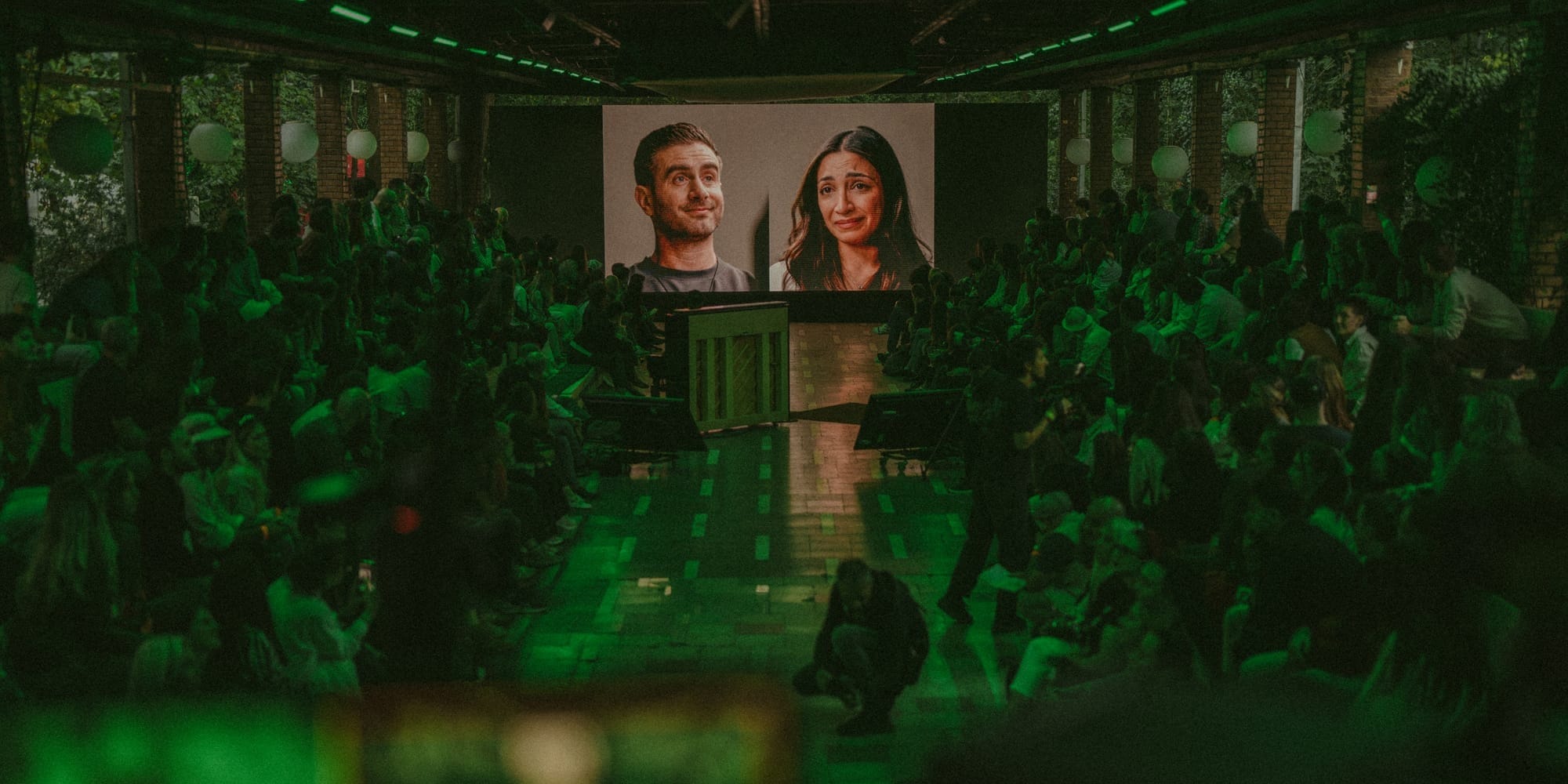
At the end of September, I spent three days in a garden in central Bucharest hosting the UNFINISHED festival. Every year they pick one word as the core theme. This year, that word was multiplicity. Orna Guralnik was there. Douglas Rushkoff. Daniel Pinchbeck. Will Storr. James Beacham. Nik Bärtsch.
Incredible people, every one of them with multiple facets to their work, their passions, and the way they impact the world. And the word "multiplicity." A big beautiful word, right? Many things at once. Many aspects, many selves, many truths sharing the same room.
The everyday word for it, the common word, for me, is and.
Which I found funny, because I've spent the last thirteen years making a project called {THE AND}. Turns out they'd built a whole festival out of the same little word.
I am a father and a lover. A husband and a son. I can be angry and I can be patient, depending on who I'm talking to. I am different people with different people, not because I'm fake, but because that's how it works.
There are multiple versions of our beings. Two things can be true at once. And yet in today's world that seems to be very hard to consider, let alone accept.
Because the world keeps asking us to live by another word. A much more divisive word.
OR.
Either my opinion or yours. Either this party or that party. Either my children or yours. The word or forces you to choose. To pick one. One identity, one side, one box, one profile, one line under your name.
And that pressure isn't neutral. The easiest way to control someone is to disempower them by limiting their choices, by limiting their sense of possibility. It's one of the oldest tricks in the book: divide and conquer. Force people to choose a side, and in doing so, deny the plausibility of the other. Anything that wants to manage you needs you to be one thing. A person who is resolved is a person who can be sorted. It's much more difficult to influence you if you can hold two things at once.
So choosing and is a choice. And part of what you're choosing is contradiction.
You can love someone and need to get away from them. You can be grateful for the way you were raised and still be angry about it. You can be proud of something you did and ashamed of how you did it. Someone can be generous to you and cruel to somebody else, and both are true, and neither one cancels the other out.
But and is not mush. It's not that everything is everything. It's that we can hold multiple truths at once.
Of course it's much easier to simplify, to revert to the either/or paradigm. It's much more difficult to hold two things at once, especially when they feel contradictory. But contradictions exist, and we have to lean into deciphering them.
We do that by building the power to make greater distinctions.
How? For me, through my work, the most powerful tool for finding a distinction is a well constructed question. It allows you to discover something new. About yourself, about your relationship to others, and about how you perceive the world.
A good question doesn't get you an answer. It makes a distinction possible. It lets you tell two things apart that looked identical from a distance. Anger and grief. Loneliness and being alone. Wanting something and needing it.
And the distinction offers you a choice you didn't have before.
The finer your distinctions, the more agency you have over your own self and the world around you. Powered by the instrument of distinction, and becomes precision.
We're taught that holding two things is a failure of thinking. That if you haven't resolved it yet, you haven't thought about it hard enough.
I think it's the opposite.
And here's the part I didn't expect: the more precisely you can see something, the less it resolves. Vagueness is what forces you to pick a side. When you don't have the words for both things, you can only hold one. Precision is what lets you hold two.
The more contradictions you can hold, the less you need to resolve them.
Everything in the world right now, and particularly in political discourse, is asking you to pick or.
But I believe that's changing. I believe we are slowly growing out of this phase of either/or. It's been too painful to live in that mode of thought. We are not out of it by any means, but I'm starting to see glimmers of and. Of deciphering contradictions with greater precision.
It gives me hope.
Because ultimately, we cannot do this alone. One's identity doesn't live in a vacuum. It shows up in relation. In front of someone, next to someone, because of someone. You are not a fixed thing waiting to be discovered. You are made in the meeting.
That has become very clear to me filming {THE AND} conversations for the past thirteen years.
Humanity isn't within us.
It's what lies between us.
And we can only cultivate it when we create the space to use the power of distinctions, to enable our ability to hold contradictions. And ultimately, to hold one another in our shared humanity.
Topaz Adizes is the Founder of The Skin Deep, an experience design studio focused on the transformative power of human connection. He is also the host of the podcast GUTS (Getting Under the Skin) and author of 12 Questions for Love.

Comments ()